Infant and Child Massage Coaching: The Newest Seedling in Growing Garden 🌱
Growing Garden: A Lifetime in the Making
I remember my mother gently tracing my eyebrows with her fingers to help me relax and fall asleep. My mother married at 19, and I was born one year and five days later. She was only 20 years old. I wonder how nervous she must have been as a young mother. I remember hearing stories about myself standing at the top of the stairs screaming. I don't remember those moments, but I imagine how scary that must have been for her. What I do remember is her fingers gently tracing my eyebrows. She didn't call what she did a massage. She just knew it innately.
All these years later, I recognize that gentle touch through the Ayurvedic marma points I've studied and now use in most every massage, including Bhruh Antara, Bhruh Madhya, and Bhruh Agra. Ayurveda has used marma therapy for thousands of years, and these points are traditionally associated with calming the mind, relieving stress, and promoting relaxation. Now, in my infant massage training, I learned a massage stroke called Relax Your Eyes. I really can't believe how full circle my life has become. I get to share with other parents a method my mother used to comfort me all those years ago.
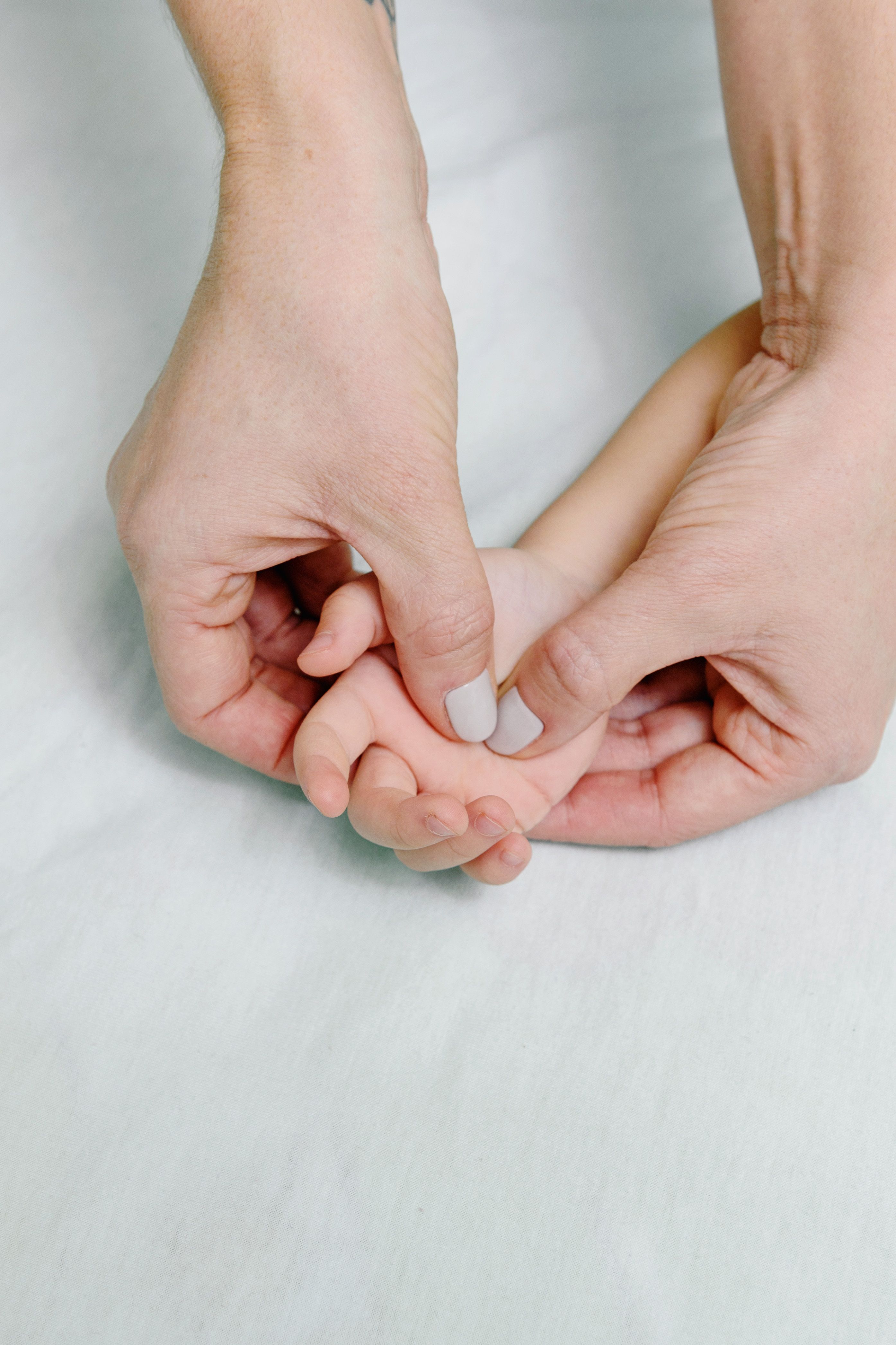
Growing Garden has been a lifetime in the making. It brings together motherhood, grandmotherhood, teaching, psychology, yoga, meditation, breathwork, Ayurveda, massage, grief, healing, and continued learning. One season of life connecting to the next. This is how we become a community. Yesterday was a big step toward my dream of creating this part of my business. I became a Certified Infant Massage Coach! This training brought together so many of my life's experiences and deepened my understanding of how nurturing touch can support a child's development, strengthen the connection between parent and child, and give parents practical ways to care for their little humans.
My understanding of the benefits of childhood massage began with my mother, but it continued through my own experience as a parent. My son's pediatrician and orthopedic surgeon taught me how massage could be used as part of his care for asthma, clubfoot, and other childhood challenges. Through those experiences, I learned how important touch could be in helping a child feel more comfortable and supported. My years of teaching, my education in psychology, and my training in Ayurveda and pediatric massage continued to deepen that understanding. When I began my infant massage training, I thought I had a pretty good understanding of the benefits. I was surprised by how much new information I learned and how the training helped me refine my understanding of WHY this work is so important to me.
One of the most thought-provoking parts of my training was learning more about Dr. Bruce Lipton's work and his idea that nature needs nurturing to reach its maximum potential. I taught science to my students for 25 years, and I had taught them about the nucleus as the control center of the cell. Lipton challenged that familiar description by focusing on the cell membrane, which receives signals from the environment and helps regulate the cell's response. His interpretation of the membrane as the brain of the cell made me reconsider something I had taught for years. What especially captured my attention was the relationship between our environment and gene activity. Epigenetics helps us understand how environmental influences can affect the way genes are expressed without changing the underlying DNA sequence. The thought that our environment can influence biological development, even after birth, made me think about the importance of the experiences we provide for our children.
We also discussed how an infant begins experiencing the environment before birth. I was fascinated to learn that newborns recognize familiar scents associated with their mothers and that this sensory learning begins so early in life. My teacher shared her thoughts about how Lipton's work connected with the sensory integration model, explaining that positive, organized, regulated sensory input can support positive responses. I loved that connection. It brought together my background in psychology, my years of teaching, and my understanding of Ayurveda. It also reminded me that an infant is constantly learning from the environment, and that touch is one of the earliest ways a child experiences the world.
Another important part of our discussion was Maslow's hierarchy of needs. At the foundation of the pyramid are our physiological needs, including the need for rest, nourishment, and the regulation of our body's internal environment, known as homeostasis. Safety and security are also fundamental to our development. My teacher repeatedly reminded us, "When you touch the skin, you touch the brain." Our tactile system allows us to experience and respond to touch, and nurturing touch can help an infant regulate physiological and emotional responses. When a child feels safe and secure, the child is better able to explore, learn, and engage in the activities of daily living. This made me think about how important it is to provide positive tactile experiences as our children's sensory systems continue to mature and develop.
I also thought about children who experience frequent medical procedures, blood tests, or other uncomfortable forms of touch. Imagine being a little human whose early experiences include so much poking and prodding. How important it is to have moments of gentle, nurturing touch as part of that experience, too. This is one of the reasons I feel so strongly about helping parents learn infant and childhood massage. I want to empower them with ways to support their child's developing tactile system, encourage regulation, and create experiences of comfort and security. My role as an infant and child massage coach is to teach parents how they can positively influence their child's development through nurturing touch and the environment they create together.
We explored several benefits of infant massage, including relief, relaxation, stimulation, and bonding and attachment. Relief is especially important when an infant is experiencing discomfort. Babies can experience gas, digestive difficulties, colic, reflux, and sensory overload, and that discomfort can lead to crying. We all know that terrible, helpless feeling of not being able to comfort our child. I feel for parents when they are exhausted, frustrated, and trying so hard to figure out what their baby needs. Gentle massage can provide comfort, support relaxation, and give parents another way to respond to their child's discomfort. Learning these strokes also helps parents become more familiar with their baby's cues, which is such an important part of understanding and responding to their needs.
Relaxation is another benefit that really connects to my own childhood experience. I think about my mother tracing my eyebrows and how that gentle touch helped me settle down and fall asleep. Sleep is one of the pillars of health, and we know how difficult life can become for the entire family when a baby is having trouble sleeping. Massage can become part of a comforting bedtime routine, helping parents create a familiar transition from the activities of the day to a quieter evening. I also love the idea that these moments of relaxation can support the parent. When you are trying to soothe a crying baby, having something gentle and familiar to do can help you feel more connected and confident in your ability to comfort your child.
Stimulation and its relationship to growth and development was another fascinating part of my training. We discussed the research of Tiffany Field and her colleagues, who studied the effects of massage and gentle movement on premature infants. In one study, 40 premature babies were divided into two groups. The babies receiving the structured touch and movement intervention had three 15-minute sessions each day for ten days. The researchers found that these babies gained 47% more weight per day than the comparison group and were discharged from the hospital an average of six days earlier. I found those results remarkable, and I have Tiffany Field's book on the way because I want to learn more about her research.
Just imagine what those six days could mean for a premature baby and the family. Six fewer days of hospital life for a little human who has just entered this unfamiliar world after the cozy stay in Mom's belly. Six more days for the family to be together at home, settling into their new lives. When I think about premature babies who need so much medical care, I also think about the importance of providing comforting touch and helping parents feel involved in their child's care. This research deepened my appreciation for the role touch can play in infant care, and it made me even more excited about continuing my education.
One of the most meaningful things I learned was that the benefits of nurturing touch go both ways. It isn't just the child receiving the massage who benefits. The person giving the massage can experience benefits, too. Nurturing touch supports the bonding and attachment process, helping parents and children connect through physical contact, eye contact, and learning to respond to one another. My teacher discussed the hormonal responses associated with nurturing touch, including oxytocin, which plays a role in social bonding. I love the idea that while a parent is learning to comfort their child, the experience can also help the parent feel more connected, relaxed, and confident.
And that brings me right back to my mother. She may have been nervous, uncertain, or exhausted, but the memory I carry all these years later is of her comforting me. I wonder what those moments were like for her. Did she feel calmer as I settled down? Did she feel relieved when I finally fell asleep? Did she realize how much that simple act of love would mean to me decades later? She was using her own hands to comfort her child, and now I am learning how to teach other parents to do the same. There is something so beautiful about that connection.
My mother and father both worked hard, and I see how hard parents are working today through my own children. Parents are balancing jobs, daycare, raising children, household responsibilities, and so many other demands on their time. Sometimes children are dropped off at daycare early in the morning, and by the time everyone is home again, there is dinner, bath time, and bedtime. Finding time to bond can be tricky. I imagine what it could mean for parents to learn a few simple massage strokes that they can use throughout their daily activities. A gentle stroke after daycare, a little massage during the transition from day to evening, or a familiar touch as a child settles down for sleep can become part of the family's everyday routine.
I think gentle ways of soothing an infant can help the whole experience of parenting, especially during those more challenging moments. When a child has big emotions, frequent medical visits, sleep difficulties, or feeding problems, parents can feel helpless and frustrated. I know that feeling, and I have so much compassion for parents who are doing their best to help their children. Having these massage strokes gives them another way to connect and respond. Instead of feeling that they need to find more time in an already busy day, they can bring nurturing touch into the moments they are already sharing with their child. The parent gains knowledge and confidence, the child experiences comfort and connection, and together they develop their own ways of communicating through touch.
Perhaps that is another important part of Growing Garden: helping parents discover what my mother discovered all those years ago, that they have something to offer their children through their own hands. I want parents to feel empowered with knowledge and practical skills that support their children's development and their relationship with them. I want them to feel confident in their ability to provide nurturing touch, especially when life becomes difficult. Through infant and childhood massage, I get to bring together my experience as a mother, grandmother, teacher, Ayurvedic practitioner, and massage therapist, along with everything I continue to learn.
I really can't believe how full circle my life has become. From my mother's fingers gently tracing my eyebrows to my own experiences raising children, and now to teaching other parents, one season of life continues to connect to the next. Growing Garden is bringing together so many parts of my life, and I am excited to share this knowledge with families and help create a community where we continue to learn, nurture, and grow together.
And I get to be the guide on the side.
Keep Life Yummy.
PJ
Acknowledgments
With gratitude to my infant massage teacher, Laura Barnhart, and Pediatric TheraTools for my training and the Relax Your Eyes illustration. I also acknowledge Dr. Bruce Lipton and Dr. Tiffany Field, whose work inspired further learning and reflection.